
Game Changer | The Lowdown on Fuelling for Youth Sport
Helping young athletes perform at their best is not just about training sessions and match days. Nutrition plays a critical role in supporting energy levels, recovery and long term athletic development. Getting fuelling right can improve performance, reduce fatigue and help young players enjoy their sport more consistently.
Some might overlook fuelling as part of their sporting success, but the potential gains of strategic nutrition, whether marginal or significant, can be the difference between first or second on the track, or having the energy availability to score the winning penalty after extra time in the Cup Final.
In this article, I break down how to fuel effectively across the week, before matches or competition, and during activity to optimise mental focus and physical performance in any sport.
For youth athletes, performance starts long before the whistle blows. Many parents focus heavily on what their child eats immediately before a match, but the reality is much broader. Good fuelling habits are built over days, not hours.
The key principle is simple: consistent, well-timed nutrition supports energy availability, while poor fuelling can lead to fatigue, reduced performance and slower recovery. In fact, players who begin competition with lower energy stores have been shown to cover less distance than those who are properly fuelled.
Understanding how to structure nutrition around training and competition gives young athletes a real advantage.
Fuelling Starts in the Week, Not on Game Day
One of the most important takeaways is that match day nutrition is only the final piece of the puzzle.
Preparation begins earlier in the week, with a focus on a balanced diet that meets overall energy needs.
Young athletes should aim to eat regular meals that include carbohydrates, protein and healthy fats. Carbohydrates are especially important as they provide the primary fuel for high-intensity activity.
The day before competition is particularly important. Consuming plenty of carbohydrate helps fill muscle glycogen levels, ensuring energy is readily available for the next day.
Hydration also matters. Drinking enough fluids the day before supports both performance and concentration.
Pre-Game Nutrition: Timing Matters
On competition day, the goal shifts from building energy stores to topping them up.
3 hours pre-activity - Eat a main meal, opting for a familiar, easy to digest meal rich in carbohydrates. Pasta or rice dishes are ideal, with a small amount of protein included such as chicken or tuna.
60-90 minutes pre-activity - A top-up snack can help maintain energy levels, again focused on carbohydrate-rich and limiting protein and fat at this stage. Toast or a bagel with honey or jam is a good option.
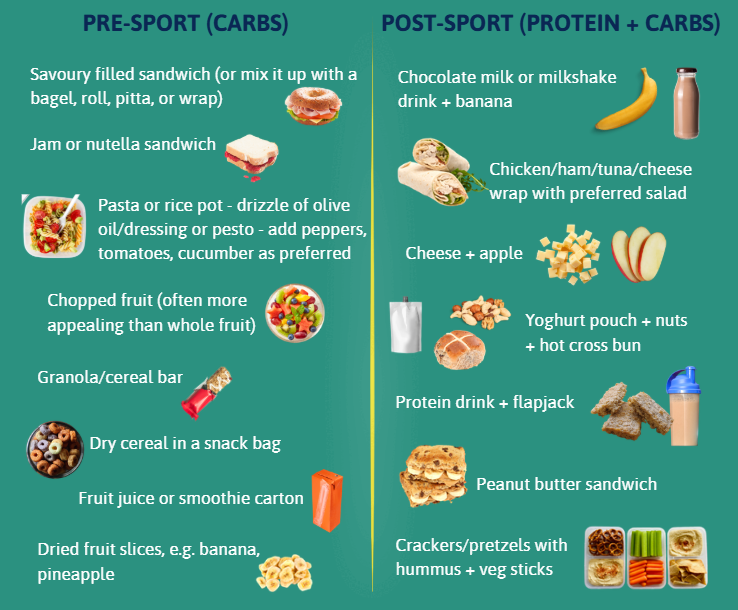
30 to 40 minutes pre-activity - A simple carbohydrate snack such as a banana, handful of berries or grapes, or a cereal bar. A small glass of fruit juice is a good alternative if the young athlete is nervous and doesn’t want more food.
The aim is to provide the body with readily available energy, laying the foundations a few hours prior then strategic top-ups closer to the start time to optimise both stamina and speed (or the fast response, agile movements required in many sports).
During the Game: Maintaining Energy Levels
For longer matches or tournaments, maintaining energy during play becomes important.
Simple carbohydrates can be consumed during breaks to sustain performance. The aim is to typically keep sipping on a sports drink through half time or breaks in the competition schedule, or alternatively take on 4-5 sweets or easily consumable fruit like grapes, in addition to water.
There is often concern from parents around sugar consumption, but in this context it plays a useful role when used strategically, in simple terms when the body is going to use the glycogen rather than store it. The key is timing and moderation rather than avoidance.
Post-Game Recovery: Refuel and Repair
What happens after the game is just as important as what happens before it.
Post-match nutrition switches to refuel and replenishing vital energy stores to support recovery, helping muscles repair and being ready for the next training session or match. At this point the strategy changes.
30-40 minutes post-activity: Consume a combination of protein and carbohydrates. This helps repair muscle tissue and restore glycogen levels. Practical options include: chocolate milk and a banana, a yoghurt or protein pouch and an apple, a sandwich with chicken, ham or egg.
1-2 hours post-activity: A main meal containing protein, carbohydrate and fat is required for the body to refuel and repair optimally.
Rest of the day or before bed: Top up with cereal and milk and healthy snacks.
The vital point is not to restrict food intake before or after sport. As explained in my previous blog, young athletes require a phenomenal amount of energy to fuel all areas of their lives.
Making It Practical for Parents
The biggest challenge for many families is not understanding nutrition, but applying it consistently.
Start by focusing on routine. Regular meals, balanced snacks and good hydration habits will have the biggest impact. Then layer in match day strategies once the basics are in place.
It is also important to keep things realistic. Young athletes do not need perfection. They need consistency, variety and enough energy to support both growth and sport.
Planning ahead can make a big difference. Preparing snacks in advance, knowing match schedules and having easy options available removes last-minute stress and helps young athletes stay properly fuelled.
Fuelling young athletes is about more than a pre-match snack. It is a structured approach that begins during the week, builds through the day before competition and continues through to recovery after the game. There is no doubt that a properly fuelled athlete has the potential to be a game changer!
At Future Athletes we focus on a health-first integrative approach to sports nutrition, always considering the energy needs for school, sleep, growth, mental focus and day to day life before applying specific strategies for sports performance.
FAQs
1. What should a young athlete eat before a sports match or competition?
A balanced meal rich in carbohydrates (e.g. pasta or rice) around three hours before activity is ideal, followed by a light snack such as a small cheese or ham sandwich around 1hr to the start, and a simple carbohydrate top up (berries, sweets or fruit juice) around 30-40 minutes before.
2. Are sugary snacks okay before or during sport?
Yes, when used at the right time. Simple sugars can provide quick energy before and during activity, but they should not replace balanced meals.
3. How important is post-sport nutrition?
Very important. Eating a combination of protein and carbohydrates within 30-45 minutes helps recovery, reduces soreness and prepares the body for the next session.
4. How can I feed my child effectively whilst travelling to and from their sport?
Young athletes and their parents tend to spend a lot of time in the car, therefore it is vital to have simple, practical solutions for fuelling and recovery in the important periods before and after training or matches. Download the Future Athletes free guide ‘On-the go nutrition solutions for Young Athletes’ for some easy ideas.
Adam Lloyd MSc mBANT is a nutritional therapist specialising in sports nutrition for youth athletes. Adam graduated in Nutritional Therapy from the University of Worcester in 2019, followed by an MSc in Sports Nutrition in 2022. He continues his professional development with the Centre for Integrative Sports Nutrition. He is registered with BANT governing body and listed on the Complementary and Natural Healthcare (CNHC) register.