
More Than Strength | What Benefits do Parents (and the Research) Report about Youth Strength Training
When many parents hear the words Strength Training or Strength & Conditioning, they often picture children lifting weights to become stronger, faster or better at their chosen sport.
While these are certainly important outcomes, decades of research now tells us that well-designed youth Strength & Conditioning (S&C) programmes offer far more than physical improvements. Today's evidence suggests that appropriate strength training can help young people develop confidence, movement skills, resilience, mental wellbeing and a lifelong enjoyment of physical activity.
At Future Athletes, we recently asked parents what benefits they had noticed since their child began attending our sessions. The responses closely reflected what the scientific literature has been telling us for years.
Strength remains the foundation
Unsurprisingly, the most consistent finding across research is that youth strength training significantly improves muscular strength.
A large study by Lesinski and colleagues (2016), involving more than 1,800 young athletes, found that muscular strength showed the greatest improvements compared with other physical qualities such as sprint speed and jumping ability.
Strength underpins almost every athletic movement. Whether a young athlete is sprinting down a football pitch, accelerating from the starting blocks, changing direction in netball or producing power on the bike, greater strength provides the foundation upon which these movements are built.
In our own Future Athletes parent survey, 100% of parents reported improvements in their child's strength, making it the most commonly observed benefit.
“He’s noticeably improved his strength and core stability, which has transferred directly into the sports he plays.” (JB, Future Athletes parent)
Better movement leads to better performance
The purpose of youth S&C is to help young athletes move better and develop long term athleticism, not to become stronger as a standalone outcome.
Research consistently demonstrates improvements in sprinting, jumping, agility, coordination and overall sporting performance following structured resistance training programmes. Young athletes primarily become stronger through improved neuromuscular coordination, learning to recruit muscles more effectively and developing better movement mechanics.
Parents in our survey reflected these findings. Nearly 70% reported improvements in sports performance.
Confidence may be the greatest hidden benefit
One of the most interesting developments in youth strength training research over the past decade has been the increasing recognition of its psychological benefits. Children who become physically stronger often become mentally stronger too.
International consensus statements highlight improvements in self-esteem, self-efficacy and confidence.
For young people, learning a new lift, mastering a challenging movement or achieving a personal best provides regular opportunities for success. Over time these small achievements accumulate, helping young athletes develop belief in their own abilities.
Our survey produced very similar findings, with three of the five most commonly reported benefits related to confidence:
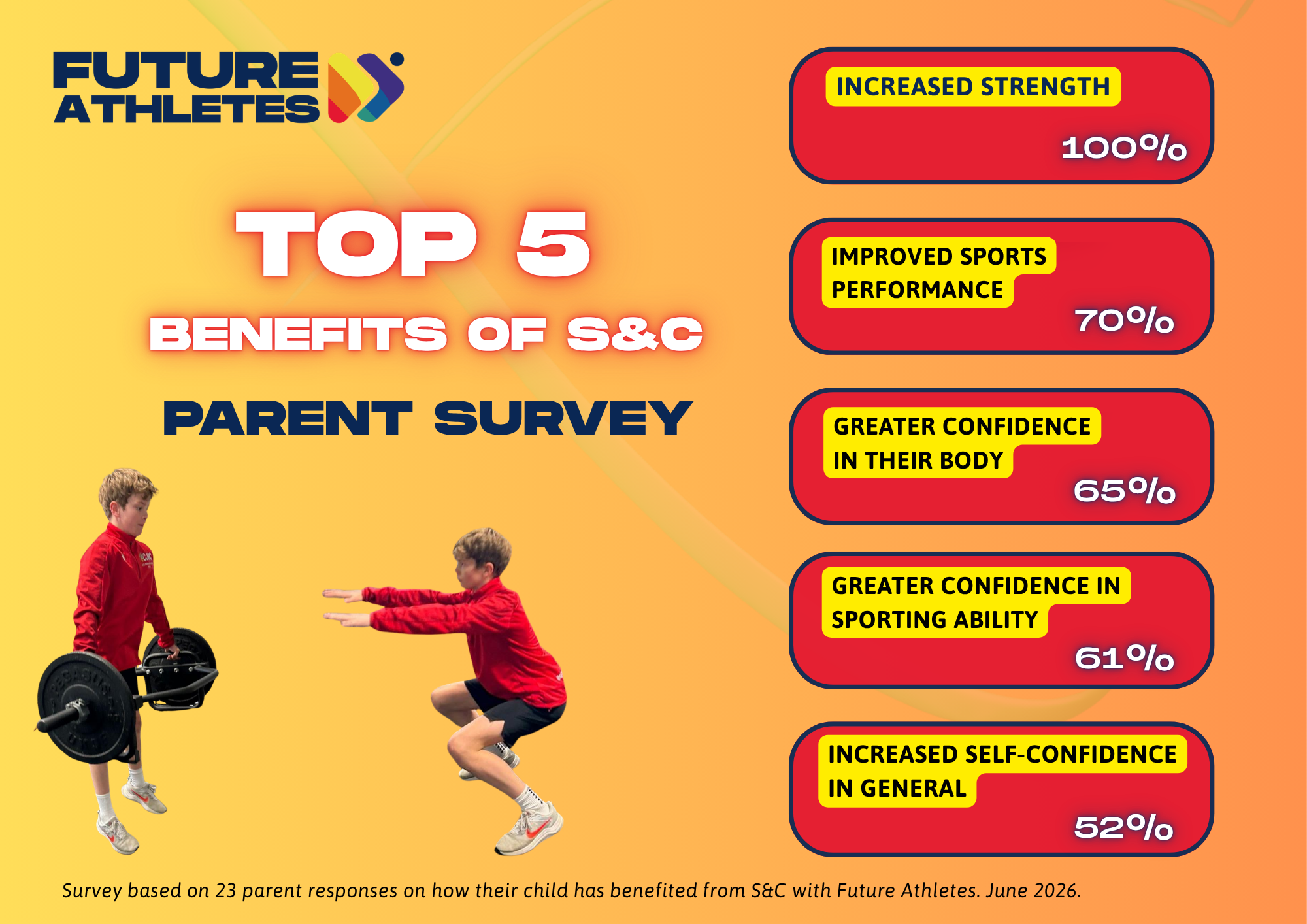
65% noticed that their child had greater confidence in their own body.
61% reported their child had greater confidence in their sporting ability.
52% noticed increased self-confidence generally.
“He loves the sessions and gets a lot out of it - it improves his physical fitness for his other sports but it also gives him increased confidence.” (KB, Future Athletes parent)
Youth strength training is safe and effective
For many years there were misconceptions that strength training was unsafe for children or could damage growth plates. These myths have now been thoroughly challenged by decades of high-quality research.
International position statements from organisations including the National Strength and Conditioning Association (NSCA), the UK Strength and Conditioning Association (UKSCA) and the International Consensus on Youth Resistance Training all conclude that appropriately supervised strength training is both safe and highly beneficial for children and adolescents.
The key is not the age of the child, but the quality of coaching. Programmes should be age-appropriate, focus on movement quality before load, and be delivered by suitably qualified coaches who understand the physical and psychological needs of young athletes.
Supporting long-term athlete development
Youth Strength & Conditioning is sometimes misunderstood as something reserved for elite performers, however this is a myth as it plays an important role for children of all sporting abilities.
Developing strength, coordination, balance and movement competency during childhood creates a physical foundation that benefits participation in virtually every sport.
Rather than specialising too early, young athletes who develop broad athletic qualities are often better prepared for long-term sporting success and overall physical health.
This philosophy aligns closely with modern Long-Term Athlete Development (LTAD) models, which emphasise movement competency and physical literacy before highly specialised training.
Whether a child dreams of playing professional sport or simply wants to enjoy being active, the foundations of strength and conditioning are invaluable.
Building resilience and reducing injury risk
Another important area of research concerns injury prevention.
Systematic reviews have demonstrated that appropriately designed strength training programmes can reduce the risk of sports injuries, particularly when combined with jumping, landing and change of direction training.
Interestingly, only 26% of parents in our survey reported fewer injuries.
This may appear lower than expected, but injuries are thankfully relatively uncommon events and are not always immediately obvious to parents. Preventing an injury is much harder to recognise than seeing improvements in confidence or strength.
The absence of injury often goes unnoticed until something would otherwise have happened.
For this reason, injury prevention remains one of the most valuable, yet least visible, benefits of youth S&C.
“Adam worked with my son, his physio, and his post op guidelines to assure that his rehab was safe, effective, and so importantly for a child; fun, engaging and meaningful.” (SR, Future Athletes parent)
More than physical development
Parents also reported improvements that extended beyond sport.
Many observed positive changes in mental and emotional wellbeing, while others highlighted increased discipline, respect and social confidence.
Although these outcomes are more difficult to measure scientifically, they reflect the wider role that structured physical activity can play in a young person's development.
At Future Athletes, we aim to create an environment that encourages camaraderie, peer support and a sense of community in our training sessions, and we see first-hand how the young people develop social confidence over time.
Bringing research to life
When the experiences of parents closely mirror findings that have been consistently reported across decades of research, it provides encouraging real-world evidence that these principles are translating into practice.
At Future Athletes, our aim has never simply been to help young people lift heavier weights. It is to help them develop athleticism, confidence, self-belief, respect and resilience, and set them up with a healthy mindset and strong body for their long term future in sport and life.
Frequently Asked Questions (FAQs)
Is Strength & Conditioning safe for children and teenagers?
Yes. When supervised by appropriately qualified coaches and tailored to a child's age, stage of development and experience, Strength & Conditioning is considered both safe and highly beneficial. International organisations including the UKSCA and NSCA support youth resistance training when it focuses on safe technique, gradual progression and appropriate exercise programming.
Will Strength & Conditioning make my child bulky?
No. Children and young teenagers generally do not have the hormonal profile required to build large amounts of muscle mass. Instead, they become stronger through improvements in coordination, movement efficiency and neuromuscular control. The result is a stronger, more athletic young person rather than a bodybuilder.
My child already trains several times a week. Do they still need Strength & Conditioning?
In most cases, yes. Playing a sport develops sport-specific skills, but it does not always develop the strength, balance, coordination and movement quality needed for long-term athletic development. Strength & conditioning helps build these foundations, which can improve performance across a wide range of sports while also helping to reduce injury risk.
What is the biggest benefit of youth Strength & Conditioning?
Research consistently identifies improved muscular strength as the primary physical adaptation to youth strength & conditioning. However, one of the most interesting findings from both the scientific literature and our Future Athletes parent survey is the impact on confidence. Alongside improvements in strength and sports performance, many parents reported increased confidence in their child's body, sporting ability and self-belief, demonstrating that the benefits extend well beyond physical development.
References
Faigenbaum AD, Lloyd RS, MacDonald J, Myer GD. Citius, Altius, Fortius: Beneficial Effects of Resistance Training for Young Athletes. British Journal of Sports Medicine.
Lesinski M, Prieske O, Granacher U. Effects and Dose Response Relationships of Resistance Training on Physical Performance in Youth Athletes: A Systematic Review and Meta-analysis. British Journal of Sports Medicine. 2016.
Lloyd RS, Faigenbaum AD, Stone MH et al. Position Statement on Youth Resistance Training: The 2014 International Consensus.
National Strength and Conditioning Association. Position Statement: Youth Resistance Training.